

Understanding How Genetics Helps Distinguish Correlation from Causation
When researchers discover that two things are associated, an important question always follows: does one actually cause the other?
For example, people with low vitamin D levels may have a higher risk of developing certain diseases. Individuals with obesity often have altered thyroid hormone levels. Patients with autoimmune thyroid diseases frequently have other immune-related conditions.
But are these relationships truly causal, or are they simply correlations influenced by other factors such as lifestyle, age, diet, or underlying health conditions?
Distinguishing correlation from causation is one of the greatest challenges in medical research. This is where Mendelian randomization (MR) has emerged as a powerful tool in modern genetic epidemiology.

Why Observational Studies Are Not Enough
Traditional observational studies can identify associations between a potential risk factor (called an exposure) and a disease (the outcome). However, these associations may be affected by confounding factors or reverse causation.
Imagine that researchers observe people with lower thyroid hormone levels also have a higher risk of cardiovascular disease. Does reduced thyroid function increase cardiovascular risk? Or do other factors, such as obesity, physical inactivity, medication use, or chronic illness, influence both thyroid function and heart disease?
Similarly, if patients with a particular disease have lower vitamin D concentrations, we cannot immediately conclude that vitamin D deficiency caused the disease. The disease itself may reduce vitamin D levels, or both may be influenced by completely different factors.
Randomized controlled trials (RCTs) are considered the gold standard for establishing causality because participants are randomly assigned to different interventions. Unfortunately, RCTs are often expensive, time-consuming, and sometimes impossible or unethical to perform.
Mendelian randomization offers an elegant alternative.
What Is Mendelian Randomization?
Mendelian randomization is a statistical method that uses naturally occurring genetic variation to investigate whether an observed association between a risk factor and a disease is likely to be causal.
The method is based on a simple biological principle first described by Gregor Mendel: genetic variants are randomly inherited from parents at conception. This natural random allocation resembles the randomization process used in clinical trials.
This concept is illustrated in Figure 1. While participants in randomized controlled trials are randomly assigned to intervention or control groups by the investigator, individuals in Mendelian randomization studies are naturally “allocated” to different levels of an exposure through the random inheritance of genetic variants at conception.
This natural randomization helps minimise confounding and enables researchers to investigate causal relationships using observational data.
Because genetic variants are assigned before birth, they are generally not influenced by lifestyle, environmental exposures, disease progression, or most confounding factors encountered in observational studies.
In Mendelian randomization, genetic variants associated with an exposure serve as instrumental variables (or genetic instruments) that allow researchers to estimate the causal effect of that exposure on a disease outcome.
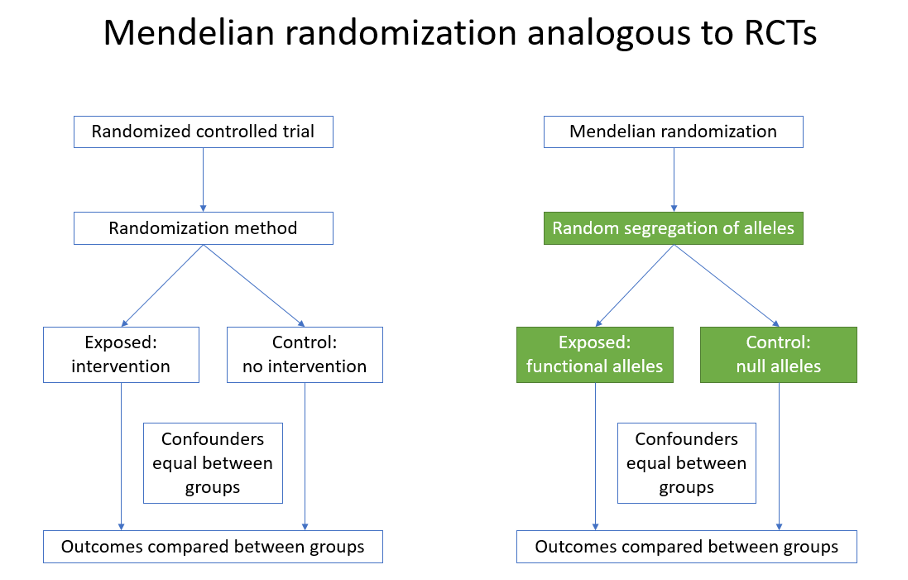
Figure 1. Mendelian randomization as a natural analogue of a randomized controlled trial. In randomized controlled trials, participants are randomly assigned to intervention or control groups by the investigator. In Mendelian randomization, the random allocation of genetic variants at conception creates groups that are generally balanced with respect to confounding factors, allowing causal relationships to be investigated using observational data. Adapted from Davey Smith & Ebrahim (2005).
How Does Mendelian Randomization Work?
The basic concept is straightforward.
First, researchers identify genetic variants that are robustly associated with a specific exposure, such as:
- thyroid-stimulating hormone (TSH)
- free thyroxine (fT4)
- vitamin D levels
- body mass index
- cholesterol concentrations
- inflammatory biomarkers
These variants are identified through large genome-wide association studies (GWAS), often involving hundreds of thousands of participants.
Next, researchers examine whether the same genetic variants are also associated with a disease outcome.
If genetic variants that increase (or decrease) the exposure consistently lead to a higher (or lower) disease risk, this provides evidence supporting a causal relationship.
In other words, instead of asking:
“Do people with higher TSH develop disease more often?”
MR asks:
“Do people who are genetically predisposed to have higher TSH throughout their lives also have a different risk of developing disease?”

Why Is Mendelian Randomization So Powerful?
One of the major strengths of MR is its ability to reduce bias.
Because genetic variants are inherited before birth:
- they usually cannot be changed by disease,
- they are independent of lifestyle factors,
- they are less affected by confounding than conventional observational studies.
As a result, MR often provides stronger evidence about causality than observational research alone.
Importantly, MR does not completely replace randomized clinical trials. Instead, it complements them by helping researchers prioritize which biological pathways are most promising for further investigation and potential therapeutic intervention.
The Three Core Assumptions
For Mendelian randomization to provide reliable causal estimates, three key assumptions must be satisfied.
1. Relevance
The genetic variants must be strongly associated with the exposure of interest.
2. Independence
The genetic variants should not be associated with confounding factors that influence both the exposure and the disease.
3. Exclusion Restriction
The genetic variants should influence the disease only through the exposure being studied, and not through alternative biological pathways.
Researchers routinely evaluate these assumptions using a range of statistical sensitivity analyses, helping ensure that the conclusions are as robust as possible.
Mendelian Randomization in Thyroid Research
Mendelian randomization has become an increasingly valuable tool for understanding thyroid biology.
Researchers have applied MR to investigate questions such as:
- Do thyroid hormone levels causally influence cardiovascular disease?
- Does thyroid function affect obesity or metabolic syndrome?
- Is vitamin D involved in autoimmune thyroid diseases?
- Does thyroid function influence bone health or cognitive decline?
- Are circulating biomarkers involved in thyroid cancer development?
Rather than relying solely on observational associations, MR allows researchers to determine whether these relationships are likely to reflect genuine biological mechanisms.
Such evidence is particularly valuable when identifying potential therapeutic targets or deciding whether an intervention is likely to improve patient outcomes.

Mendelian Randomization in the InnoThyroGen Project
Within the InnoThyroGen project, Mendelian randomization is used to identify biomarkers and biological factors that are likely to play a causal role in thyroid diseases.
By integrating large-scale genome-wide association study (GWAS) data with advanced statistical methods, MR enables us to distinguish variables that are merely associated with thyroid disease from those that are more likely to contribute directly to disease development.
This information is particularly valuable for the development of the integrated thyroid disease risk prediction tool being developed within InnoThyroGen.
Rather than selecting biomarkers based solely on observational associations, MR helps prioritise variables with evidence of causality for inclusion alongside polygenic risk scores (PRS) and clinical characteristics.
Combining genetic predisposition captured by PRS with causally relevant biomarkers has the potential to improve risk prediction, support earlier identification of individuals at increased risk, and contribute to more personalised approaches to thyroid disease prevention and management.
Together, Mendelian randomization and polygenic risk scores form complementary components of the InnoThyroGen analytical pipeline, providing the evidence needed to develop a robust and clinically relevant integrated risk prediction tool.
Looking Ahead
The rapid growth of publicly available genetic datasets has transformed Mendelian randomization into one of the most widely used approaches in genetic epidemiology.
Today, researchers can investigate thousands of potential causal relationships using data from international biobanks and collaborative genome-wide association studies involving hundreds of thousands—or even millions—of participants.
As these resources continue to expand, Mendelian randomization will play an increasingly important role in identifying disease mechanisms, guiding drug development, and advancing precision medicine.
For projects such as InnoThyroGen, this means moving beyond identifying simple associations towards understanding why diseases develop and which biological pathways offer the greatest potential for prevention, diagnosis, and treatment.
Ultimately, Mendelian randomization is helping researchers answer one of the most fundamental questions in medicine: what truly causes disease?
Author: Nikolina Pleić (University of Split, School of Medicine)
Key References
- Davey Smith G, Ebrahim S. ‘Mendelian randomization’: can genetic epidemiology contribute to understanding environmental determinants of disease? International Journal of Epidemiology. 2003;32(1):1–22. https://doi.org/10.1093/ije/dyg070
- Davey Smith G, Hemani G. Mendelian randomization: genetic anchors for causal inference in epidemiological studies. Human Molecular Genetics. 2014;23(R1):R89–R98. https://doi.org/10.1093/hmg/ddu328
- Davies NM, Holmes MV, Davey Smith G. Reading Mendelian randomisation studies: a guide, glossary, and checklist for clinicians. BMJ. 2018;362:k601. https://doi.org/10.1136/bmj.k601
- Lawlor DA, Harbord RM, Sterne JAC, Timpson N, Davey Smith G. Mendelian randomization: using genes as instruments for making causal inferences in epidemiology. Statistics in Medicine. 2008;27:1133–1163. https://doi.org/10.1002/sim.3034
